From Black Belt to Business Owner: Managing the Mindset Shift
The Complete Guide to Martial Arts Judging and Officiating: What You Need to Know
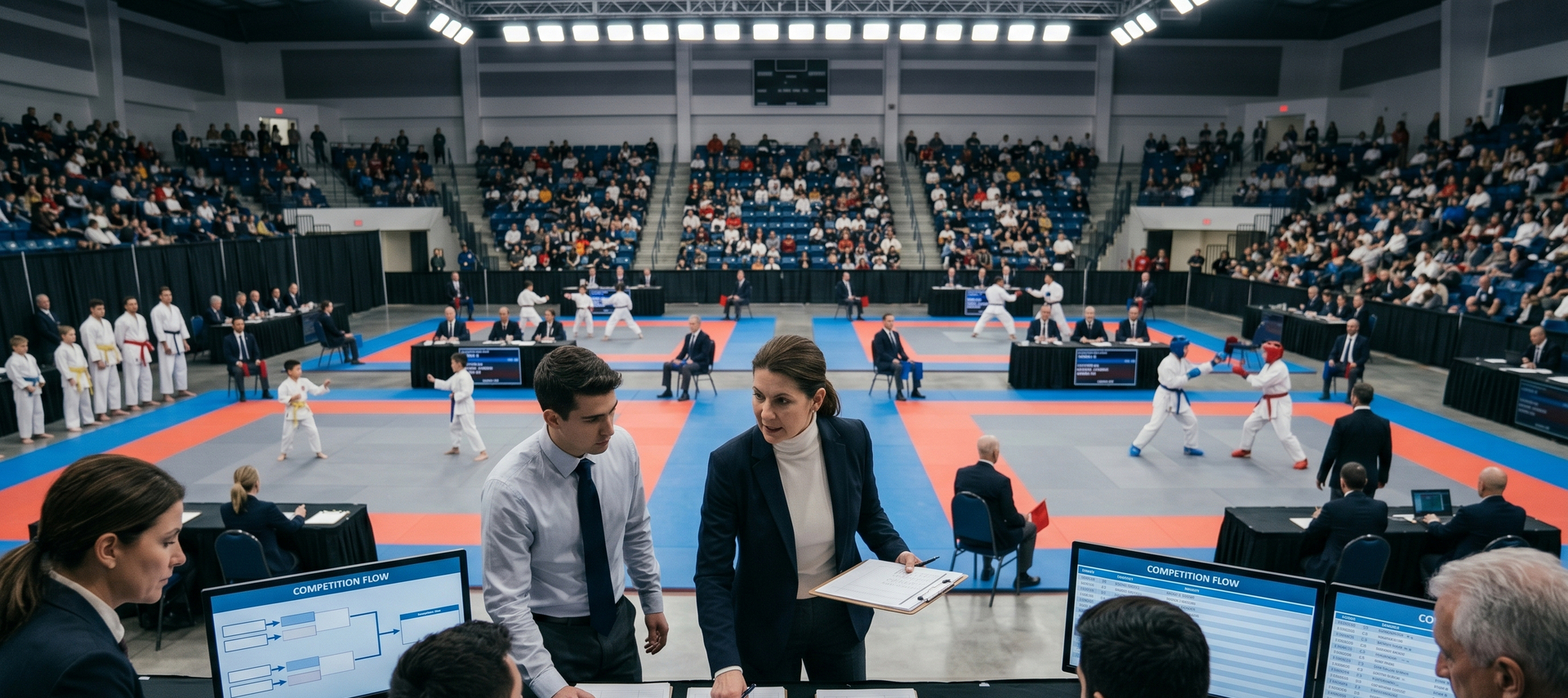
Competition is at the heart of many martial arts traditions. Whether it's a local club tournament, a national championship, or an international event, the quality of judging and officiating directly shapes the experience of every competitor.
Poor officiating damages trust in the competitive process, disadvantages athletes who have trained hard to compete at their best, and can have real consequences for rankings and opportunities that depend on competition results.
At AMACS Australia, our Judging and Officiating course is designed to give martial arts officials the knowledge, skills, and professional confidence to run competitions with integrity and consistency — across any style, at any level. This article explains what that course covers and why quality officiating matters as much as quality instruction.
Why Officiating Quality Matters
Ask any competitive martial artist about their worst competition experience and there's a reasonable chance it involves officiating. Unclear criteria, inconsistent application of rules, judges who appear to be favouring certain competitors, or officials who simply aren't confident in their role — these experiences undermine everything that competition is supposed to be about.
Good officiating creates the opposite: an environment where athletes can compete with full confidence that the outcome will reflect their actual performance. That confidence changes how people compete. Athletes who trust the process tend to compete more freely, more expressively, and more honestly — which produces better competition for everyone watching and everyone participating.
Beyond the competitive experience itself, the credibility of competition results matters for athletes whose rankings, scholarship opportunities, or professional prospects depend on those results. In the martial arts world, as in any sport, the integrity of the officiating system is the foundation on which everything else is built.
The Core Principles of Martial Arts Judging
Our Judging and Officiating course is built around a set of core principles that apply across martial arts styles, even though the specific rules differ enormously between disciplines.
Objectivity: Effective judges make decisions based on observable performance against defined criteria, not on prior knowledge of the competitor, the competitor's instructor, or personal stylistic preferences. This is harder than it sounds — cognitive biases are real and systematic, and professional officials learn to recognise and counteract them.
Consistency: The same performance should receive the same assessment from the same judge throughout a competition. Officials who start with strict standards and progressively relax them, or who apply different standards to different rounds, create unfairness even without any deliberate intent to do so.
Transparency: Athletes and coaches need to understand how judging decisions are being made. Where rules allow for it, officials should be able to explain their decisions clearly. Where appeals processes exist, they should be navigated with the same professionalism as the original judging.
Integrity: Officials must be free from conflicts of interest and must manage the appearance of conflicts as carefully as actual conflicts. An official who has a personal connection to a competitor may make perfectly fair decisions — but if the appearance of fairness isn't maintained, the credibility of the outcome is compromised.
Evaluating Competitors Across Styles
One of the distinctive features of our Judging and Officiating course is its style-agnostic approach. The foundational principles of evaluating competitors — understanding scoring criteria, recognising and assessing quality of technique, managing timing and boundary calls — apply across disciplines.
This is valuable because many competition environments involve officials who are expert in one style being asked to judge in a mixed-style context, or being called upon to officiate at events with different rule systems than they normally work with. An official with a solid grounding in the underlying principles of competition assessment can adapt to new rule sets much more readily than one who has only learned the specific rules of their home discipline.
Our course includes practical application components that give students experience applying judging principles in realistic scenarios — not just learning the rules in the abstract, but developing the confidence to apply them consistently under the pressure of an actual competition environment.
The Role of the Head Official
Competition management involves more than individual judges making scoring decisions. Someone needs to coordinate the panel, manage disputes, ensure that the competition runs to schedule, and maintain the overall integrity of the event.
Our Judging and Officiating course covers the responsibilities of senior officials in addition to those of individual judges — because many of our graduates go on to design and run competitions, not just participate in them as judges.
This includes competition administration skills: how to design a draw that is fair and efficient, how to manage ring time effectively, how to handle incidents and disputes professionally, and how to communicate with athletes, coaches, and event organizers with appropriate authority and clarity.
The Package Course Option
For instructors who want comprehensive professional credentials, we offer our courses in combination. Taking our Judging and Officiating course alongside AMACS Levels 1, 2, and 3 gives you a complete instructor qualification that covers teaching, coaching, and officiating — the full spectrum of professional roles in a martial arts school.
This combination is particularly valuable for instructors who are building competition programs as part of their club offering. Being able to train your students for competition and manage the competition environment to a professional standard is a significant competitive advantage for your school.
Senior instructors who have completed all four components — Levels 1, 2, 3, and Judging and Officiating — are among the most comprehensively qualified martial arts professionals in the country. That's a credential worth building toward.
Becoming a Better Instructor Through Judging
One of the unexpected benefits that our Judging and Officiating graduates frequently report is that learning to judge has made them better teachers.
Judging requires you to articulate precisely what good technique looks like and what distinguishes excellent execution from adequate execution. When you've had to define these criteria in a competition context — where your assessment is on the record and subject to scrutiny — you develop a much clearer and more precise language for talking about technique with your students.
Instructors who judge competitions are also regularly exposed to the full range of how a technique or discipline can be expressed — across different body types, training backgrounds, and competitive styles. That exposure broadens your understanding and makes you a more nuanced and flexible coach.
The practical work of judging and the professional development it requires feed directly back into the quality of your instruction. It's one of those rare investments that pays off in multiple directions simultaneously.
Enrol in Our Judging and Officiating Course
Our Judging and Officiating course is available as a standalone qualification or as part of a combined package with our instructor levels. It's delivered entirely online through our Martial Arts Universities portal, so you can complete it in your own time without disrupting your existing commitments.
Whether you're a club owner looking to build officiating capacity within your organisation, a competitive instructor who wants to develop the skills to run your own events, or an experienced official who wants a formal recognised credential to back your existing experience — this course is designed for you.
Visit our courses page to learn more about the Judging and Officiating course, or contact us to discuss whether an RPL pathway might be appropriate given your existing experience.
Share
Teaching Self-Defence Professionally: The Course Built for Instructors Who Work With Real-World Risk